sticta

Recently, our dye group worked with the common New Zealand lichen Sticta coronata; unlike many lichens, this species is relatively quick-growing and widespread and so its harvest poses less of a threat to existing populations. Apparently it yields a wide range of colours from purples, pinks and browns to yellows and gold, depending on the pH of the dyebath. We only made two dyebaths, one with tapwater and the other with tapwater plus a capful of ammonia. I ended up with soft purple and pink.

Mordanted wool with ammonia afterbath and mordanted wool

Mordanted wool with ammonia afterbath and mordanted wool

I’d like to play around with it, lowering the pH with vinegar to see what that produces… I’m guessing it would take the colour towards the golds and greens. Anyone know?

pokeberry

I’ve been keen to try dyeing with this weedy species (there are numerous pokes around the world but I’m pretty sure the one found in southern Australia is Phytolacca octandra) since I saw it growing at Werribee Gorge last year. I’d read about it in Rebecca Burgess’ Harvesting colour and know the genus from my herbalist days (Phytolacca decandra is a great lymphatic and glandular remedy) but didn’t think I’d ever get my hands on it until I stumbled on it on a bushwalk.  I was kicking myself that I couldn’t get back out to the gorge in time to harvest the ripe berries and then one day found a self-seeded plant in a housing estate around the corner from my house!

IMG_1448

Phytolacca berries

Apparently dyers have long eyed off the purple-black berries as a dye source (even its names serve to tease- phyto= plant, lacca= red dye, common name Inkplant) but couldn’t get the colour to hold… and then the experiments of natural dyer Carol Lee led to the discovery that the pH of the dyebath must be low (acidic) for the pigment to bond to fibres. Revolutionary!

So, temporarily putting aside my greed for usable quantities of dyed yarn (I tend to jump in instead of testing and sampling!), I picked a small handful of berries and heated them gently while pre-mordanting a small hank of wool/ silk with vinegar according to Rebecca Burgess’ instructions. At first, the dyebath was a lovely dark pink but it slowly got paler and paler until all colour was lost- I added the yarn anyway and simmered it for 45 min… and ended up with a very pale yellow-green, not the dark red I was expecting. It started me thinking about cold-dyeing instead- it seems like lots of berries and fruit yield clearer and longer-lasting colours that way- and then found that Dre of grackle and sun had done just that and had great results! So I followed her wonderful advice and steeped the berries (and racemes) in 100% vinegar in a large jar for a month and then added the yarn and left the whole thing to soak for another 10 days. I then removed the skeins, left them to dry and then rinsed them really well to remove the vinegar. I wasn’t sure how leaving yarn in pure vinegar would affect it but it feels fine.

And the results…

IMGP0496

Cold pokeberry on mordanted and unmordanted wool and mordanted wool/ silk

IMGP0537

Initial and subsequent experiments

I’m incredibly excited to get such amazing colours from a weed with no input except vinegar and time 🙂  The wool/ silk yarn is much paler because only the wool fibres seem to have picked up the colour, even though silk often dyes more readily than wool- another enigma!

I was also keen to see how different the colour would be with hot-processing so, once I’d removed the yarn from the jar, I put the remains of the dyebath in a pot with enough water to cover, simmered for 1.5 hours and then added some more vinegar-mordanted yarn, holding the dyebath at 70C for 2 hours as per Rebecca Burgess’ instructions. And the result is quite, quite different.

IMGP0585

Hot pokeberry on mordanted wool

I now need to test them all for light-fastness. I wonder if I’ll get the same results as Dre for this… her work, as well as that of Carol Lee and Rebecca Burgess, has really inspired me to experiment more, whether that be playing around with pH, different methods of dyeing or plants I haven’t tried before. Thankyou!

purple basil

Once you get a taste for dyeing with plants, you start to question the potential of everything around you: plants in your garden and surrounding landscape, your fridge, your food cupboard and even your medicine cabinet if you’re into herbs! I recently bought a bunch of purple basil to infuse in oil and serve with baked vegetables; rather than leaving the remaining half-bunch to turn to sludge in the fridge, I simmered it in water for 45min, strained the leaves out and added some yarn pre-mordanted in alum and cream of tartar to see if any of the dark red of the dyebath would bond to it.

Purple basil on wool/ silk and wool

Purple basil on wool/ silk and wool

Interestingly, the wool/ silk took up a lot of colour, while the wool just a touch, whereas sometimes the opposite happens. I’m starting to think there must be affinities between certain plant pigments and certain fibres… or perhaps the capacity for bonding is pH-related. It’s an enigmatic art.

otways camping

We just had two days of much, much-needed time in the bush! There was: lovely, soothing rain, walks in the Otways rainforest and at Johanna Beach and Blanket Bay, campfires, sandwiches toasted on said fires, rock-and-shell-collecting, time for those long, rambling conversations that only happen on a long drive somewhere, breakfasting with wallabies, laughter, tears, music and other good things. I need to keep reminding myself how good for the soul camping is, especially during this last year when life has been engrossing and tough.

I also had a very brief play with my new camera- a big thanks to my friend Matt for deciding to upgrade and pass his Nikon d80 to me. Now I really have to spend some time learning how to get out of auto mode this year. We saw a whole lot of koalas down there, doing what they do most of the time- eating, scratching and sleeping! Even Australians don’t tend to get over the cuteness of these little fellas and it seemed like a good time to try the new camera.

Contemplating a scratch

Contemplating a scratch

Scratching...

Scratching…

...

Settling in…

... for a...

… for a…

... very...

… very…

DSC_0455

… big…

... sleep... zzz ....

… sleep… 

ursula

Happy 2013 to you all! I really hope there has been some resting and relaxing in your small corner of the world and that you have some good plans for 2013… we’ve been sweltering in Melbourne since late December (there are small and large bushfires burning all over the southern parts of Australia, which is very worrying) and yet, in a bizarre repeat of last year’s holiday, I started a colourwork project, Kate Davies’ Ursula. You’d think that holding a strand of yarn in one hand would be enough in this kind of weather but I’m going two-handed- nuts! I’m not sure if I’m trying to evoke my cool, damp memories of Shetland by knitting a Shetland-inspired cardigan with Shetland yarn or what, but something seems to be working, as I’m totally loving both the emerging fabric and the knitting of it… so that’s a good start to the year!

Ursula

Ursula

Ursula

Ursula

I can’t get the colourwork to lie flat enough to get a clear shot of the design but hopefully you get the idea. I’m super pleased with the colours (Jamieson and Smith 2-ply and Rowan Scottish Tweed), which is a relief as I find it hard to know how colours are going to interact until I’ve knitted quite a large piece! The main colour is Scottish Tweed in Herring, a wild and elusive colour that looks blue-grey but actually has a bit of everything in it.

IMGP0415

Herring

I wasn’t sure how the other colours would work with it but I they seem to pick up and highlight all the different shades in the blend.
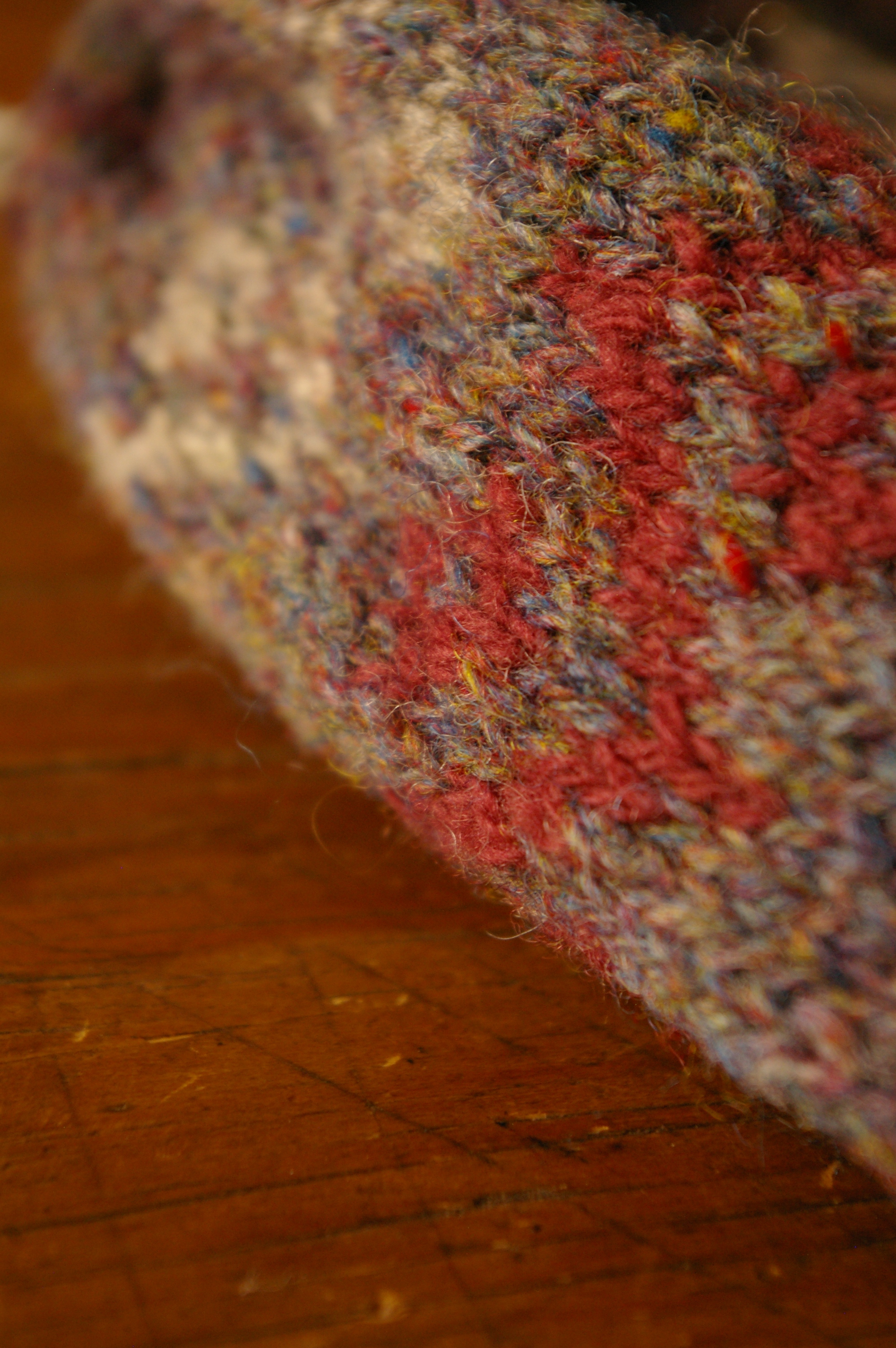
Wine, herring and natural

Wine, herring and natural

This’ll be my first full-size, steeked colourwork project and I’m pretty excited! For you non-knitters, steeking involves knitting a garment as a tube and, at the same time, inserting columns of extra stitches where you want the armholes and front opening to be and later cutting up those columns to enable you to work the openings. This is done because knitting colourwork is much quicker and easier in the round! Below, you can see the columns of stitches that form the steek.

Steek!

Steek!

It’s been a while since I felt this excited about knitting and what I was making- I feel like I’m learning to knit all over again! I want to keep pushing myself to try to learn new things, so I have to thank Kate for providing that inspiration- as always, she’s produced a beautiful, well-written design with lots to keep me engaged and some solid techniques to learn.

I’m converting the design to a v-neck as I always wear cardigans unbuttoned and I think it’ll hang better that way. As always, I’m finding myself being extra-cautious about not working the colourwork too tightly and so my tension is a bit looser than it should be! I think the end product will be a bit bigger than planned but that kind of suits me- I’d be quite happy if my cardigan was slightly grandpa-ish, rather than fitted (shh, don’t tell Kate!) and I may add pockets later if that is the case. A friend told me that the colours reminded him of James Herriot (a great compliment given that he, along with David Attenborough, was my biggest childhood crush!) and I guess I’m hoping that the finished cardigan will fit in in the city but hint at its island roots!

What’s your first knitting/ sewing/ writing/ planting/ creative project for the year?!