Category Archives: knitting and yarn

samples 3

My new favourite pattern.

Leaves

Or is it this way up?

Scales; tiles; shingles

I love it either way. The photos really don’t do justice to the colours of this beautiful Portuguese yarn, a warm natural and a complex heath green.

Meme 35 laceweight singles from Portugal

But hopefully you get the picture.

The shade cards for the yarn I’d like to use for my colourwork idea arrived and I have poring over them…

Blues

So many to choose from that it is kind of baffling. I’m finding the process similar to creating a garden- far easier if you have a some parameters to work within because a blank canvas can be overwhelming. I do have some clear parameters but the process is definitely making me define where I want to go with this- questions like, how willing and confident am I to trust my own sense of colour and pattern? Do I have the diligence to work carefully and consistently through the process and can I broaden my vision to see what will really work, rather than just get distracted or disabled by the glut of choices? And, if this is something I want to produce to sell, how much do I follow my own colour choices and how much should fashions in colour influence me? This process is such a great thing for me because I can be a bit of a dreamer! So, now to make the final choices… ; )

samples 1

The first of a series of posts (mostly photos) on some knitted samples I am making for an idea I have.

The first six

I am not particularly conscientious about sampling for handknitting, although I do do it- though only for jumpers and the like. I have even got into the habit of washing and blocking my swatches, a very grown-up habit. But for this, I am really into it! Looking at patterns and their rhythms, as well as tension and the ideal fabric for this project, is beautiful, and the fact that the samples are done on my vintage knitting machine means that the whole process is actually viable time-wise…

(For those not familiar with them, these motifs are part of a massive collection of pattern cards put out by knitting machine card manufacturers over the last fifty or so years. The whole concept is amazing, as the cards are multipurpose and can be used for a number of different stitches- inevitably, I got stuck on their application on colourwork, because I am mad on patterns and colour, but they are equally beautiful when used in slip, tuck and weave. One of my knitting machine heroes, the lovely, patient and generous Christine, inherited a huge box of them, many very old, and let me rummage through- and man, was I in heaven.

So I am working my way through the pile of the most promising cards, making swatches using the ends of balls and shades that I don’t want to use for anything else. Which means that the colours in the samples are not what I imagine for the end product and that I end up with a motley, disparate collection of swatches. But it feels good to use all those small odds and ends. Makes room for the many colours I’ll be bringing into the little room, if all goes well.

Recycled shetland and lambswool yarn

Noro waves

Deco-inspired

Pyramids

I’d love to know if there are any patterns that you particularly like or dislike… Or colour combinations that do or might work for you. A little bit of market research. And a warning- there’ll be more in the next little while so please be patient with me- very excited!

flax and linen

This is a beautiful and informative short film on the production of flax and linen… I saw it a little while ago on Lena Corwin’s blog and was transfixed. Around the same time, I was given a skein of Swedish laceweight linen. I have sewn with linen but never knitted with it… so it should be a lovely new thing to try, either on the needles or on my machine. Hmmm…

galina’s lace

While in Bothwell, I was super-excited to meet Galina Khmeleva, a Russian knitter and spinner now based in America, who is doing an incredible job of spreading the word about the knitting traditions of Orenburg, Russia.

Orenburg laceknitters

In a region characterized by long, bitter winters, hot, dry summers and poor soil fertility, the people of Orenburg have been known for their knitted shawls (both gossamer and heavier-weight) for over three hundred years. The Orenburg goat adapted to the severe winters of the Ural mountain steppes by producing a very fine, downy undercoat similar to cashmere and mohair and this was recognized as a resource that could be used to keep warm and bring in much-needed income.

Each goat yields only 100-150gm of fibre each year, so it is necessary for a family to keep at least a few animals in order to produce enough fibre for shawl-making. The goats are kept outside throughout the year and are combed during molting in spring; the fibre is then thoroughly cleaned and spun into a very fine but durable thread which is then plied, usually with commercially spun silk to add strength and stability and to speed up the process.

Each gossamer shawl (pautinka) then takes one to two months to knit; it may be triangular, square or rectangular and is characterized by geometric lace motifs, intricate edging and a fabric that is as durable as wool but far warmer, lighter and loftier. Like the Shetland ring shawls of Scotland, a true gossamer Orenburg shawl should be able to be passed through a ring and will weigh 100 grams or less.

Gossamer-light Orenburg lace shawl

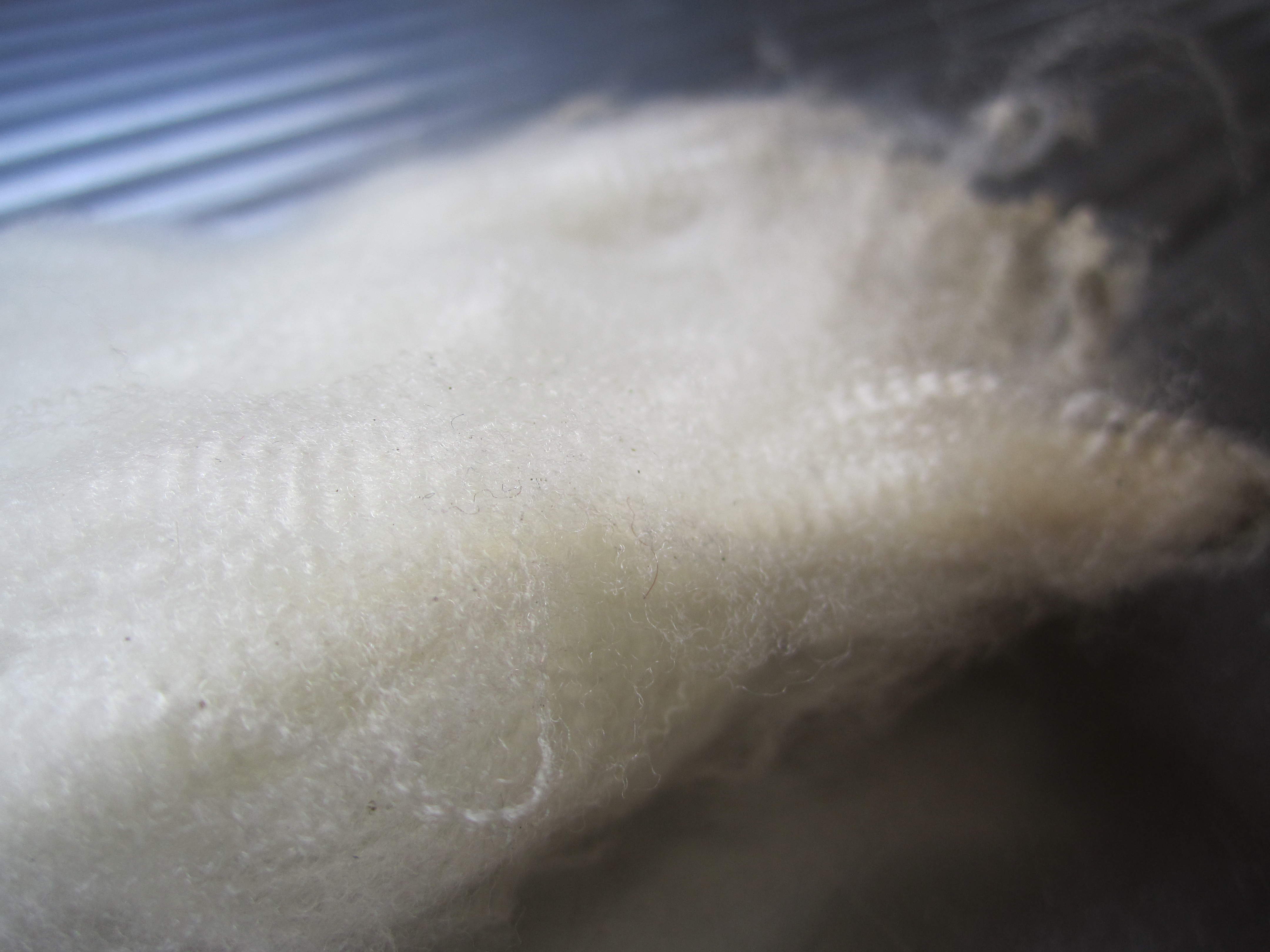
A closer look highlights the incredible downyness and loft of Galina's handspun yarn

Traditionally, the techniques used to create the Orenburg shawl were passed from generation to generation within a family and no written instructions or patterns existed. During the Soviet period, shawlmaking became a state-controlled industry, so much so that many laceknitters struggled to survive without government support when communism fell. Luckily, several master laceknitters of Orenburg agreed to share their wealth of knowledge and skills with Galina, who spent a huge amount of time translating and transcribing what she learned from them and who now travels extensively to share the beauty of the tradition and to pass on the skills used in creating an Orenburg shawl. She is currently holding a series of classes across Australia, including several with the NSW Handknitters Guild and a two-day workshop at Morris and Sons in Melbourne… and I think there are places left in that one! My finances are super-tight at the moment but I am hoping for a miracle so that I can attend! My impression from hearing her speak at Bothwell was that she would be a wonderful teacher, both funny and a bit bossy so able to get the best out of students.

Here she is!

Cheeky smile ; )

And, if you can’t get to learn with her in person, try to get hold of a copy of her book… it is a great combination of history and how-to. I’m saving my pennies for that too…

craftcamp, bothwell and knitcamp 1 and 2

A change in fortune and schedule has led me to make a couple of small trips in the last little while… I was lucky enough to be invited to one of the lovely Sooz‘s craftcamps with a contingent of women who completely blew me away with their respective talents and capacity for laughter, storytelling, pattern writing, pastry-making, abstract patterning, multi-tasking, frog-catching and producing incredible amounts of beautifully sewn garments! I was humbled by the experience. Thanks to you all!

And last weekend, my friend Kylie had a stall at the Bothwell Spin-In and I went along to help sell her lovely hand-dyed yarn and fibre. Held in the tiny highland town of Bothwell in Tasmania, this biennial event has been going for  33 years and is a lovely meeting and merging of small-scale fibre and yarn producers, craftspeople, farmers interested to see what sells and (excuse the cliche) husbands tinkering with handmade gadgets designed to make crafting more enjoyable ; )

We were blessed in being invited to stay with the Downie family at Dungrove, the original developers of the Cormo sheep!! Man, what an amazing honour. They were incredibly generous and patient, answering all our questions about the breed and its development in the late 1950’s, and graciously held back from teasing us about how little we really knew about “tender” fleeces, wool classing and sending fleece to America by Australia Post!

Cormo sheep, Dungrove, Tasmania 

A staple of Dungrove Cormo fleece 

We took some of their fleeces to the Spin-In to show the attendees, because, despite the fact that the Cormo was developed ten kilometres up the road, many had never heard of the breed or tried spinning or knitting with its fibre… in fact, most Australians haven’t. The softness and spring that are characteristic of the Cormo make it very popular in other parts of the world- so most of the Downie’s fleeces are shipped out to be turned into socks. We should be using it here… so Kylie is working on a plan. Keep an eye out on her website!

And another trip coming up in a couple of months is our inaugural Knit Camp! After my friend Amy and I went to the UK Knit Camp in Scotland last August, we kept wondering why Australia didn’t have its own knitting camp… so a few of us have organized one! Just a little one for 22 people. No teachers this time- just skill-sharing and time out to knit together. It is already full- and so we are planning another, all things going well! It is going to be big and beautiful. And without all the chaos of the UK version. So keep an eye out and save your pennies because we’d love you to come along…