Category Archives: knitting and yarn

scarves for japan

I just heard about this undertaking by (mostly) Japanese students to gather warm woollies for those affected by the Japanese earthquake. The weather will start getting cold there in a couple of months and apparently material aid is slowing down, so Kenta and his gang of volunteers are asking for handknitted hats, scarves, gloves and babywear…

Blossom booties

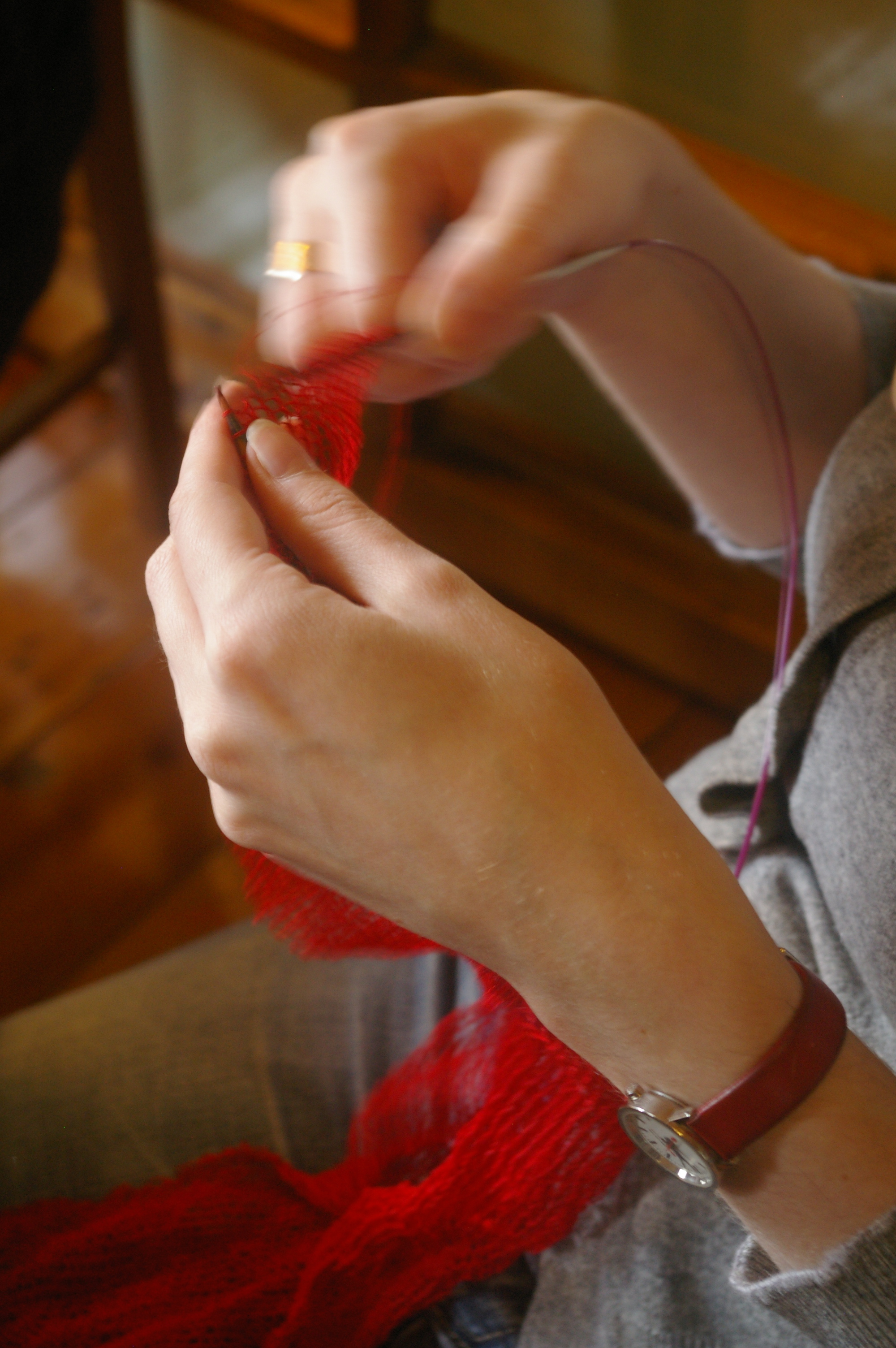
Why handknit? As Kenta says, “we want to remind the victims that there are still people trying to help them”. Apparently handknit covers handworked knitting machines- and I’m sure crochet, weaving etc. would be great too- which is wonderful as I can make a lot more on my old Singer than I could by hand ; )

I’m aiming to send as many as I can by the end of September and would be really happy to put yours in the box too… just drop me a line.

esha ness

A walk last year….

Horse drinking; Dore Holm, Esha Ness

Coastline

Ocean, cliffs and seabird

Deep inlet gouged out by the ocean; Calder's Geo

Moss, lichen and rock

Water-polished stones

Creator of fine Shetland yarn ; )

and the shawl inspired by it…

Waves of old shale patterning

Soft and cosy

Shetland colours

Ocean and sky

Moss, lichen, earth and sheep

Finally finished, my enormous hap shawl inspired by a day spent walking the magnificent Esha Ness in Shetland… I love it! A hybrid of Gudrun Johnson’s and Madeleine Weston’s haps, using yarn from Jamieson and Smith, Rennie and Holstgarn. Details here.

colouring

Recently the yarn- all 9kg of it!- that I ordered for my colourwork project arrived and I’m feeling like a kid in a lolly shop! I tidied and organized my work area in anticipation and have settled it all into its new home. Rather than being naked in all its glory, each cone is housed in its own bag- I am developing a major phobia of moth attack – so I made up a shade card to keep me tuned into the seventeen different shades I have at my fingertips ; )

Shade card; Shetland yarn from Holst Garn

I’ve put aside (only for a little while!) the project that got me ordering the yarn in the first place, as it involves combining machine knitting and sewing and, apart from the fact that I am a crap sewer, for the moment I just want to focus on getting familiar with using this yarn on my lovely old machine… things like adjusting tension to create the right fabric for any given project, observing how the colours interact and how to play with that and technical issues such as seaming and dressing the fabric once it is made up into a piece. I’m having heaps of fun!

The potential of colourwork on the machine was really clear to me last year when I started learning how to use my machine but I’ve been waiting for this yarn to appear before really starting to explore- I reckon that, like patterning in hand-knitting, it is really all about the combination of yarn and pattern. And that is a very delicate thing. There is a high risk of wrong moves and things getting way too much heavy with colour/ pattern and so I’m trying not to overthink the process and to go by feel. Some things that I thought would work didn’t- which is great because it is opening me up to experimenting more. And that is stimulating quite a lot of ideas for diverse and unexpected ways to use this lovely fabric… and I am also seeing all the skills I now need to work on! So I am making very simple shapes, playing around with density and drape and working on ways to get around the major challenge with this type of colourwork- the floats catching on things.

My lovely machine knitting friend Christine took me along to one of the local guild meetings to have a chat about what I have been doing and making. I felt like a complete sham speaking to a group of women who knew far more about the craft than I do and embarrassed about the meagre number of items I had to show them… so I spoke a lot about my “ideas” and the reason I am so interested in this aspect of machine knitting ; ) It was great to get their feedback (though hard to put myself out there!) and some answers to some of the questions and issues that I spoke of. Another huge reminder of the huge value of community and peer support and why I shouldn’t shut myself in my room and knit all day.

I haven’t had anyone around to model the things I’ve made but will post photos as soon as I do; in the meantime, here are some more “textural” shots ; )

(I can’t seem to show the depth and richness of colour- so much is lost when uploading from iPhoto to WordPress that things end up looking either dull or garish. You’ll have to take my word for the beauty of this yarn.)

Circles and rods double thickness scarf; sky-blue and rust-red

Deco fern neck warmer; sea-blue and dark olive

Cell fingerless mitts; sea-blue and jasper

Orchid kimono sleeves; forest green and sage blue

knit camp

The barn and dyeing room at Tasma House

A handful of us have spent the last few months organizing a weekend of knitting in Daylesford, a small town near Melbourne… and it finally happened this last weekend! So much preparation and anticipation and, in the end, everything ran beautifully, other than the burst water main that meant we had no running water for the greater part of Saturday- but luckily we can’t take credit for that one!

Things kicked off at midday on Friday with attendees trickling in; those lucky enough to have the day off work headed to the Creswick Woollen Mill with us to have a look at the mill’s machinery. That is, the mill’s very quiet, completely stationary machinery! Unfortunately, when I booked the tour, I didn’t specifically ask if the machine would actually be working and the operators neglected to mention that Friday is the one day it doesn’t run… so we were a little deflated. Still, we managed to get pretty enthused about the big and complex machinery and downy alpaca mist covering the floor, as well as the greatly reduced pieces of alpaca and merino blanketing spun and woven by the mill (one of which came home with me to buffer our lack of heating on the cold nights we’re having this year) and the various other merino and alpaca knits up for sale. Absolutely worth a visit… but try to avoid going on a Friday ; )

Super soft and cosy alpaca blanketing woven at Creswick, Victoria

We then swung by Tailored Strands in Allendale, a small company turning great quality, locally grown alpaca fleeces into really lovely yarn. Lots of temptation there and I think quite a few of us dipped into our Bendigo yarn funds…

12-ply alpaca; the colour is much richer and more interesting than it appears here...

By dinnertime, everyone had arrived and we settled in for a mammoth weekend-long knitting session. Loads of amazing projects were on show, including this sweet jumper knitted by Jo, which was very in keeping with the style of the place…

Fairisle Yoke Sweater

And a highlight for me was having the chance to touch and examine yarns that I’ve only read about before. On hand were rare shades of Wollmeise and the work of other highly-sought-after indie dyers, as well as yarns made of fibres as diverse as buffalo, Orkney angora, stainless steel and Jacob.

Sarah and her stainless steel

Heaps of skills were shared, both in classes and in informal exchanges. Several campers generously agreed to give classes free of charge (thanks so much again, all of you!) and all were super informative and enjoyable. Heather and Kylie demonstrated ecoprinting, using plant material from the surrounding streets and wrapping them in silk around a core of rusted iron; the colours and prints achieved were deep and lovely.

Unravelling the ecoprint

Detail of ecoprint

Heather, a textile student at RMIT, also discussed dyeing with eucalypts and showed us some incredible samples of her dyeing, on both yarn and fabric. She made the process seem quite magical and I could see the inspiration and ideas starting to form in many of our heads…

Heather's samples of eucalypt-dyed yarn

Kylie then discussed dyeing with chemical dyes and gave us some of the tips and tricks that she finds useful… just as magical a process and perhaps more tangible in the short-term!

ms gusset yarns

Next came a colourwork class with Sue and we were all blown away by her skill and creativity, not to mention her class prep! So many different techniques for incorporating colour into knitting…. even the simplest, like slip-stitches, are beautiful and impressive.

Beautiful samples of colourwork from Sue's class

Sue also spoke about the joys and challenges of designing knitwear, pattern-writing and publishing, which provided lots of food for thought, especially for the aspiring designers in the room. And Katie‘s and Audrey‘s classes went hand-in-hand perfectly; shawls and lace! So many techniques and contstruction methods, hints and enticing patterns… I think all of us have queued at least one lace shawl on Ravelry today! There were also informal demonstrations on Portuguese and continental knitting, recycling yarn from a jumper and using blocking wires, and a stash swap on Saturday night. I can’t say I came home with less yarn but it was certainly different yarn ; )

Speaking of more yarn, we all left with more in our pockets, thanks to the goodie bags that everyone received… on top of what we bought out of our budget (stitchmarkers, highlighter tape, homemade blocking wires courtesy of Amy and more), we were lucky enough to be given yarn and patterns by some lovely small producers- Skein, Ixchel Fibre and Yarn and Little Yellow Cat. We were super grateful for such generous support for our undertaking and hope that everyone enjoys the spoils! (There’s also a Little Yellow Cat KAL starting over on Rav soon if you’re interested… we’ll be knitting her Dandelion Beret).

Merino/ cashmere fingering from Skein

Bluefaced Leicester/ angora yarn from Ixchel

And a huge thanks to Chelsea, a knitter who also works in catering, for all the wonderful food and super organization!

Chelsea taking a breather from cooking and working on her Guernsey Wrap

The whole process of organizing Knit Camp has been really interesting… I’ve never done anything like this before and it really came about in response to Amy and I attending the UK Knitcamp in Stirling last August. We just wanted to be able to go to something like that without having to travel to the other side of the world- and to make that possible for others too. Now, in the wake of a really successful and enjoyable weekend, I find myself wondering where it could go and where I would like it to go… The six of us- Amy, Katie, Kylie, Jackie, Nandi and I- worked really well together but it definitely took the team to get everything done. Everyone who attended was super-quick to jump up and help when needed but it was kind of like having a party; it all goes by in a blur and you never quite relax- well, I don’t anyway ; )

We’ve spoken about making it bigger so that we could make it worthwhile for teachers from Melbourne, interstate or even overseas to run classes- and that would be wonderful but certainly a higher-risk operation and a lot more work before and during the camp. Perhaps it would be better to keep it small. What do you think? Would you prefer to pay more for a larger camp with more formal classes with wellknown teachers or a cosy group as described above? We’ll be receiving feedback from attendees but, if you have a opinion on this or would like to come to the next one and so have your say, I’d appreciate your comments…

And lastly, an almost-finished armwarmer (designed by Jackie for the camp!) knitted over the weekend in some of the the Lopo Phoebus sent to me by Fernanda. I’ve been wanting to use this yarn for ages and it is perfect for this project- but I don’t love the colour combination so I might restart with some of the other colours… I really don’t mind though- I forgot how much I love two-handed colourwork!

Armwarmers

shilasdair

I rolled my ankle this morning… which means that I am on the couch for the day, instead of my normal Friday activity of helping introduce people to yarn. I’ve been meaning to write about visiting Shilasdair for ages and today is as good a day as any.

Started in 1972 by Eva Lambert at Waternish, on the north-west coast of Skye in Scotland, Shilasdair is one of only a few yarn producers that I know of that rely entirely on natural sources of dye for their production- an amazing thing really, considering the notoriously fickle nature of natural dyeing- and, let’s face it, all small-scale dyeing. Eva and her family moved to Skye from London in the early seventies; sleepy Waternish is now part of the Skye tourist trail in the summertime but it must have been really remote back then, a perfect place if you know what you want to do and have some skills to start with, I guess, but her strength of vision is quite amazing to me.

Looking out from Waternish towards the Western Isles

It must have been a wonderful, gradual process, the development of her dyeing skills and practice, that are now so developed and coveted that the shop has passed on to a new owner, Judy, and Eva is now busily dyeing much larger quantities of yarn to be sold far away in London and beyond.

Barn and shop hand-built by Eva’s husband Tony, from stone reclaimed from earlier buildings on the site

Eva has developed a palette of dozens of rich and subtle colours through the use of just a handful of dyes; some, like tansy and meadowsweet, she sources from her own dye garden and from the surrounding landscape and others, like madder, indigo and logwood, come from much further away. Various mordants are used, yielding different colours and shades from the same dyebath, but, more unusually, yarns are submerged in one, two or even three different dyebaths in order to create shades not normally available in natural dyeing, such as greens. This technique, known as top dyeing, in combination with extremely soft water, is what has allowed Eva such a wide range of colours in her yarns.

Madder, indigo, cochineal and logwood

Tansy and meadowsweet

Dyed samples

The influence by her travels and study in fine arts is obvious in the range of designs for garments, mainly jumpers, designed by Eva and her coworkers. They are available as kits or ready-knitted by local craftspeople and really demonstrate the beauty of the textures and colours of her yarns.

Jumpers designed by Eva, Judy and Linda…

My favourite

I knew, even before I got there, that some Shilasdair would be coming home with me ; ) Sadly, Eva’s 4-ply shetland is no longer available- it was phased out in favour of more luxurious yarns that sell better- but I fell in love with this 4-ply blend of British wool, angora and cashmere.

Meadowsweet/ weld/ indigo, tansy/ indigo, and cochineal

And, cast on and knitted on the flight home, here is what I made with it…

Gypsy shawl

Soft halo; deep colours

Also ravelled here. The pattern is the wonderful, much-loved Andrea’s Shawl from Kirsten Kapur- I thoroughly enjoyed both pattern and yarn… which is lucky because I think I’ll be reknitting it! It came out super-small and, as a result, has never taken its place in my daily wardrobe- which is too great a shame for yarn so lovely. I might take it along to Knit Camp to frog over a cuppa…

Do go and check out this wonderful yarn and the dyer who creates it- she is amazingly talented, knowledgeable and committed to her craft. And I think that her yarns are really coming into their own with the current embracing of semi-solid yarns (where small dye lots and variances in colour are seen as a positive quality) and the ever-increasing interest in sustainable production practices, such as responsible natural dyeing.