Author Archives: admin

ursula

Happy 2013 to you all! I really hope there has been some resting and relaxing in your small corner of the world and that you have some good plans for 2013… we’ve been sweltering in Melbourne since late December (there are small and large bushfires burning all over the southern parts of Australia, which is very worrying) and yet, in a bizarre repeat of last year’s holiday, I started a colourwork project, Kate Davies’ Ursula. You’d think that holding a strand of yarn in one hand would be enough in this kind of weather but I’m going two-handed- nuts! I’m not sure if I’m trying to evoke my cool, damp memories of Shetland by knitting a Shetland-inspired cardigan with Shetland yarn or what, but something seems to be working, as I’m totally loving both the emerging fabric and the knitting of it… so that’s a good start to the year!

Ursula

Ursula

Ursula

Ursula

I can’t get the colourwork to lie flat enough to get a clear shot of the design but hopefully you get the idea. I’m super pleased with the colours (Jamieson and Smith 2-ply and Rowan Scottish Tweed), which is a relief as I find it hard to know how colours are going to interact until I’ve knitted quite a large piece! The main colour is Scottish Tweed in Herring, a wild and elusive colour that looks blue-grey but actually has a bit of everything in it.

IMGP0415

Herring

I wasn’t sure how the other colours would work with it but I they seem to pick up and highlight all the different shades in the blend.
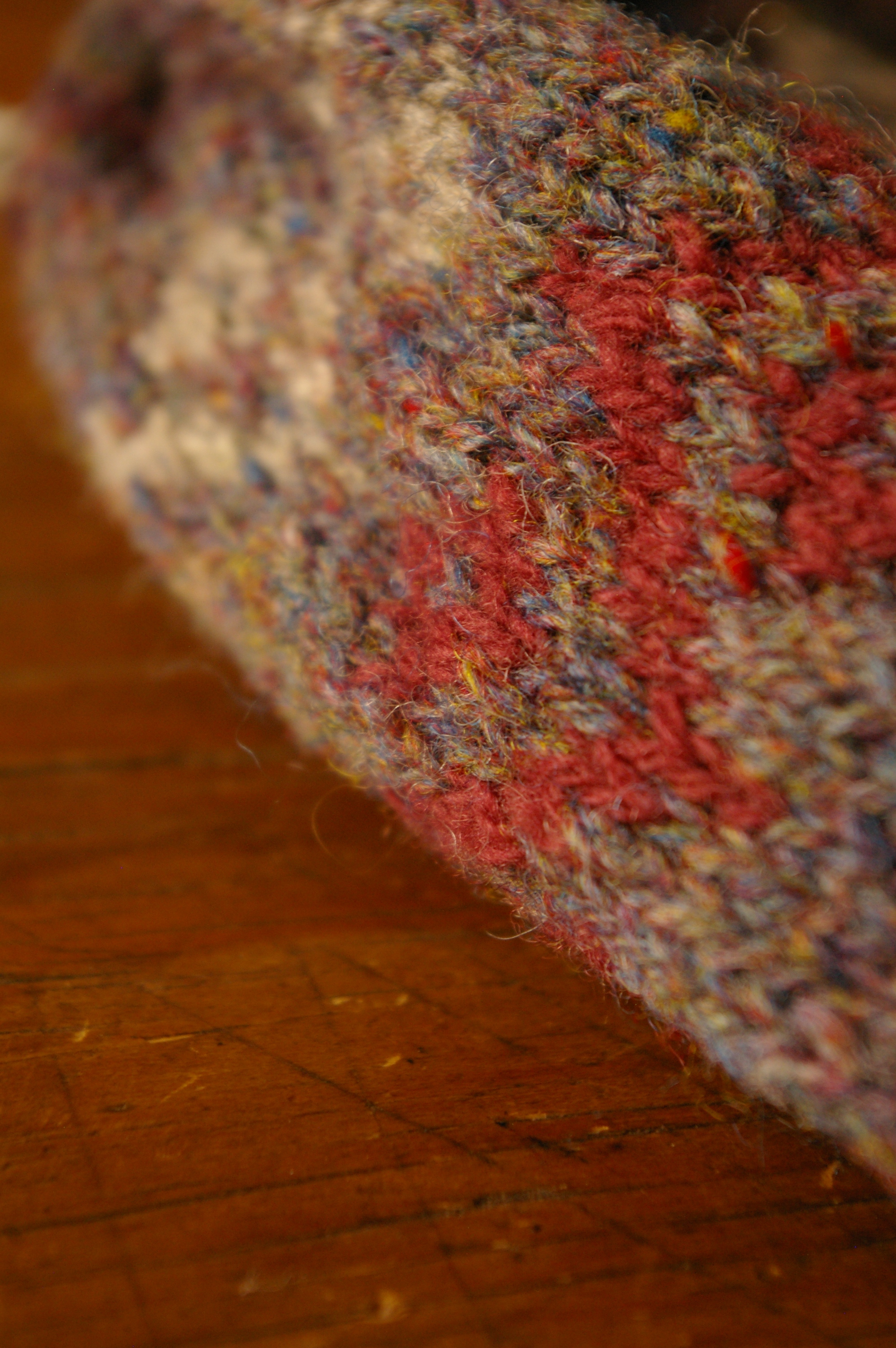
Wine, herring and natural

Wine, herring and natural

This’ll be my first full-size, steeked colourwork project and I’m pretty excited! For you non-knitters, steeking involves knitting a garment as a tube and, at the same time, inserting columns of extra stitches where you want the armholes and front opening to be and later cutting up those columns to enable you to work the openings. This is done because knitting colourwork is much quicker and easier in the round! Below, you can see the columns of stitches that form the steek.

Steek!

Steek!

It’s been a while since I felt this excited about knitting and what I was making- I feel like I’m learning to knit all over again! I want to keep pushing myself to try to learn new things, so I have to thank Kate for providing that inspiration- as always, she’s produced a beautiful, well-written design with lots to keep me engaged and some solid techniques to learn.

I’m converting the design to a v-neck as I always wear cardigans unbuttoned and I think it’ll hang better that way. As always, I’m finding myself being extra-cautious about not working the colourwork too tightly and so my tension is a bit looser than it should be! I think the end product will be a bit bigger than planned but that kind of suits me- I’d be quite happy if my cardigan was slightly grandpa-ish, rather than fitted (shh, don’t tell Kate!) and I may add pockets later if that is the case. A friend told me that the colours reminded him of James Herriot (a great compliment given that he, along with David Attenborough, was my biggest childhood crush!) and I guess I’m hoping that the finished cardigan will fit in in the city but hint at its island roots!

What’s your first knitting/ sewing/ writing/ planting/ creative project for the year?!

forty

That’s right… I’m forty today- how did that happen?!

hydrangea

Hydrangea

I have to say, I’ve been feeling a fair bit of trepidation about this one. My usual, yearly birthday musings about where I am at and what I’m spending my time doing have been amplified by the magnitude of that number and the struggle which my sister is going through in her life… in some ways, that’s made me much more connected with the need to make the best of my life right now and yet, at the same time, I feel acutely aware of time passing. Surely both good motivators, no? Well, yes… but being moved by a sense of urgency alone can be exhausting- I also need to learn how and when to relax and go easy on life and myself! Some of my mates who’ve already stepped over the threshold into 40 say that it’s the time of not caring so much about other peoples expectations, of letting go of some of your own, of knowing when to push and when to surrender. I’m up for that.

hydragea 3

So, my birthday wishes for the year ahead? Peace for Sarah, however that takes shape, and some family time. Tenacity. A shower (or even a bath!) in my very own, new bathroom and lots of friends in our house. The beginnings of a back garden. Some time to get to know my new, soon-to-arrive macro lens, a very generous present from my family- be prepared for lots of plant photos! A glimpse of a different horizon- NYC? Scotland? Some good creating. Is that too many wishes?! It is 40, after all- I figure I get a few extra this year!

Hydrangea

Hydrangea

workshop with susan guagliumi

A few weeks back, I was lucky enough to attend a workshop with machine knitting innovator, designer, writer and teacher, Susan Guagliumi. This woman has been on the scene since the early eighties and has a serious amount of expertise and passion for the craft, so it was a privilege to listen to her talk and to watch her demonstrate bridging on her machine. I must admit that I was so engaged by her that I didn’t absorb much of the actual techniques! I just wanted to absorb her stories, thoughts and energy… I figured I could learn the techniques from her book anytime but it’s a rare thing to have access to her in person.

Below are some of the amazing swatches she brought along to demonstrate some of the many applications for bridging.

Short-row heels

Detail of short-row heels

Chain-link cable

Tuck

Short-row wriggles

Short-row bumps, pre-and-post-felting

Rolled cable

For more on the workshop, read my lovely friend Christine’s post!

beaded

Patterned beading

I recently bought this beaded piece from the Junk Company in town. The guy who served me had no information about it but it was marked as a teapot rest. At 9cm across, it seems pretty small for that purpose, other than for a very small teapot- which, of course, do exist. Still, I’m not convinced.

The turquoise and glass beading is intact and still vibrant but there is wear on the shells, suggesting that something was either placed upon or rubbed against them repeatedly.

Turquoise and shells

Worn or missing beads

It is backed with cotton and has a black velvet edge, which both show signs of age and use. Interestingly, the brown thread used to attach the shells is visible, as are bright orange and pink threads used to work stitches between the outer two rounds of turquoise beads. It seems odd that there was no effort made to cover the back of the piece, which makes me wonder if it was attached to something else?

Back

The colours make me think of Tibet and northern China but I have no idea about beading. I’d love to hear if anyone has any ideas about what it is and where it is from?

ratanjot

Ratanjot is the Hindi name for a number of plants in the borage family (including Alkanna tinctoria or alkannet) traditionally used for colouring textiles, food (such as rogan josh!), vegetable oils, wines, medicines, cosmetics and varnishes. It is currently used as a red food colouring agent (E103 or alkannin).

The species most commonly used in India (where this plant material came from) is Arnebia nobilis, which is imported from Afghanistan. The purple-brown roots, twisted roots are covered in a papery bark from which the dye is extracted. Dark red, purple and browns are the most typical colours achieved.

Two methods were used:

Dyebath 1: powdered ratanjot mixed with alcohol and left for an hour to extract colour.

Dyebath 2: powdered ratanjot mixed with cold water to form paste and left overnight.

Warm water was then added to both preparations and both were brought to the boil and then down to simmer. Pre-mordanted yarn and fibre were introduced into both baths and left at 80c for approx 1 hour.

The yarn and fibre in dyebath 1 with alcohol all came out brown, whereas those in dyebath 2 came out soft shades of purple, mauve and aubergine. Ratanjot seems to be light-sensitive; the colours intensified and moved towards purple when the freshly-dyed skeins were exposed to sunlight. Next time, I’d like to see how pH affects the colours achieved; apparently, using an acidic vinegar afterbath results in pinkish shades, whereas and alkaline ammonia afterbath results in greyish blue.

Ratanjot on wool/ silk yarn: dyebaths 1 and 2

Ratanjot on cotton cloth